All published articles of this journal are available on ScienceDirect.

IPCC-based Scenario Analysis of Greenhouse Gas Mitigation and Carbon Credit Potential in Lagos Megacity Waste
 iD
Funsho Alaba Akeredolu1
Jacob Ademola Sonibare1
iD
Abiodun John Adewale2
iD
iD
Funsho Alaba Akeredolu1
Jacob Ademola Sonibare1
iD
Abiodun John Adewale2
iD
Authors Info & Affiliations
Abstract
Introduction
The ineffective management of MSW, where open dumping and uncontrolled burning characterize the Lagos Megacity, poses severe environmental and public health challenges while contributing to GHG emissions by a wide margin.
Methodology
The project identified the carbon credit value of the solid waste industry of Lagos through the estimation of the greenhouse gas emissions for each of the seven scenarios of solid waste management. The IPCC 2006 recommendations, with 2019 modifications for open dumping, managed landfilling, composting, anaerobic digestion, incineration, open burning, and recycling of solid waste, were used to estimate the emissions.
Results
The outcome suggests the potential for the acquisition of about 631 million CERs as a result of the transition to sustainable approaches in waste management, which, at the price of 2024, is valued at USD 1.9 billion. In contrast, the baseline situation is projected to result in significant emissions, as open dumping and open burning result in emissions of 98,463 Gg CO2 equivalent and 59,741 Gg CO2 equivalent, respectively. Conversely, composting and recycling were responsible for lower emissions, while landfills with gas recovery indicated the largest potential CERs.
Discussion
Conclusively, the results emphasize the economic as well as environmental advantages of moving away from the harmful trend towards sustainable alternatives, making it clear that carbon trading can offer a real economic incentive for bettering practices pertaining to waste management, as well as aiding in climate change mitigation in a rapidly urbanizing environment.
Conclusion
This particular research further identifies the economic potential of carbon trading with regard to waste management and climate preservation.
1. INTRODUCTION
There has been a significant increase in the production of waste all over the world in the past decades. This further creates significant environmental issues. According to the present estimate, one-third of the 2.01 billion tonnes of municipal solid waste produced every year is not properly handled. The increasing trend of the increasing level of municipal waste can be related to several factors that have been inter-linked, namely the increasing rate of urbanization, along with the increasing population and increasing industrial activities [1-4]. These factors have been found to be further aggravated in the case of developing nations. For example, the insufficient availability of waste infrastructure matches the increasing rate of the aforementioned phenomenon.
The case of Nigeria serves as an example here. The Lagos Megacity faces serious challenges in the management of solid waste. As the economic centre and the most densely populated city in the country, Lagos still faces high rural-urban migration and high population density, which exerts considerable pressure on the current waste management infrastructure [5, 6]. Open dumping and uncontrolled burning still prevail in such a way as to contribute substantively to the degradation of the environment as well as the risk to the health conditions [7]. Greenhouse gases like carbon dioxide and methane are produced when organic waste breaks down [8, 9]. In addition to the atmospheric conditions, these activities also contribute to the contamination of groundwater and soil, hence endangering ecological and health systems. Poor regulation enforcement regarding open burning, coupled with inadequate financial and technological alternatives, has impeded sustainable waste treatment in the city [10].
With the rising pressure from the global community regarding the issue of climate change, global agreements such as the Paris Accord have prompted the adoption of approaches that result in a reduction in the level of greenhouse gas emissions and further propel the reduction of carbon emissions [11, 12]. Carbon credits, therefore, have emerged as one such mechanism that has been developed and employs a market-driven approach aimed at reducing emissions by assigning a monetary value to every tonne of carbon dioxide equivalent that is further sustained or reduced in the atmosphere [13]. Cap and trade systems cause the buying of credits from others when the targeted entities overachieve the set targets on emissions, thus acting as an economic stimulus for activities involving the reduction of emissions [14, 15]. As supported by the views of the current literature, there is an opportunity offered to entities to reap economic rewards from the good waste management practices they employ by making hay from the same [16].
Some nations have shown the viability of waste management in tandem with carbon credit schemes. In Brazil, CDM projects like the Novagerar Project, involving landfill methane recovery, have shown significant methane reduction and high production of CERs [17, 18]. In India, CDM schemes like composting/biomethanation plants to produce energy and fertilizer also involve the production of CERs at substantial levels [18, 19]. In Africa, the “eThekwini landfill methane to power project in South Africa is one of the earlier successes in the production of CERs. The methane from the landfill is converted into power and then sold to the energy grid, providing economic returns to the city as well,” as stated in [20, 21]. Such success stories, as shown in [22, 23], indicate that the production of CERs can also benefit urban areas in developing nations in appropriate ways.
Technologies for Waste-to-Energy also have the prospect for emission reduction as well as waste value recovery. World over, Waste-to-Energy technology has been recognized as an alternative technology for effective waste management compared to the previous waste handling processes [24-26]. Many other nations, including the USA and the EU, have adopted the technology of anaerobic digestion, gasification, or landfill-to-energy [27-29]. These methods show the potential of Waste-to-Energy technologies in reducing environmental effects and improving energy security [30, 31]. In the case of Lagos, these technologies may offer a significant opportunity in dealing with waste, as well as contributing to global and local sustainable development objectives [10].
Despite rising interest in greenhouse gas emissions from waste, knowledge gaps persist on monetizing emission reductions from waste dump sites in Lagos. Though some studies exist on greenhouse gas emissions from landfills based on Intergovernmental Panel on Climate Change methods [32-35], few studies exist on their carbon credit potential in rapidly growing African megacities. Similar studies exist in some parts of Asia, namely India and Bangladesh, based on Clean Development Mechanism tools [36, 37], and some African cities as well [38, 39]. Nonetheless, a different set of conditions exists in Lagos that demands a closer look.
Based on the above background, this research investigates the carbon credit potential of waste dump sites within the Lagos Megacity. Greenhouse gas emissions are calculated based on different waste management options by following the IPCC 2006 Guidelines with the 2019 revisions. The paper seeks to offer evidence-based findings to inform policy development and investment choices by identifying opportunities for mitigation, quantifying the revenue that can be generated through carbon markets, and providing guidance on the pathway to more environmentally friendly waste disposal methods in Lagos.
2. MATERIALS AND METHODS
2.1. Emissions Estimation for Carbon Credit – IPCC Method
The research design for this research was Quantitative-Analytical. This was aimed at estimating the potential for reduction in the greenhouse gas emissions and the potential for the generation of carbon credits that could be obtained through the replacement of the prevailing practices of solid waste management practices in the Lagos Megacity with new approaches. The research question that was answered through this research was: What potential exists for the reduction of greenhouse gas emissions and the generation of carbon credits through the replacement of the prevailing practices of solid waste management in the Lagos Megacity with new approaches?
Methane emission estimation was done using the guidelines given by the Intergovernmental Panel on Climate Change (IPCC), in 2006, Volume 5, which was thereafter revised in 2019. The First Order Decay (FOD) model was employed for Methane production potential estimation from Municipal Solid Waste, as well as carbon credits estimation in this field [40-42]. Methane emission estimation was also done using the Tier 2 approach.
The reason why Lagos Megacity was chosen as a case study is because of its high generation rates and dependence on open dumping of solid waste. The study employed municipal solid waste generation and management information specific to a city, taking into account waste composition, climatic conditions, and characteristics of disposal sites. The information was collected from records of the Lagos Waste Management Authority, field measurements, and peer-reviewed literature [30, 43-46]. In order to account for the long-term behaviour of methane emissions from solid waste, the generation of municipal solid waste was modelled from 1950 to 2050 based on IPCC recommendations. The future generation of municipal solid waste was projected based on population growth rates and per capita generation rates of solid waste. Municipal solid waste was divided into components such as food, paper, textile, plastic, metal, and glass, and each scenario assumed that all of these components were treated by a single technology in accordance with standard practices used in emissions inventory models [41, 42].
The First Order Decay model ascertains the amount of methane emissions based on the nature of the waste, the method of disposal, as well as the amount of methane recovered, creating a sound basis for assessing the reduction of methane emissions as well as the generation of carbon credits [47]. These amounts are subsequently translated to carbon dioxide equivalent units of CO2-eq, applying Global Warming Potentials (GWP) of 265, 28, and 1 to N2O, CH4, and CO2, respectively, on a 100-year time frame [32, 48]. The method may be implemented on either Tier 1, 2, or 3, depending on available data specificity, which is either default, moderate, or country-specific, respectively, and it is well-validated by many researchers [32-35].
Seven waste disposal methods were evaluated: (1) open dumping (uncontrolled SWDS), (2) controlled landfill, (3) composting, (4) anaerobic digestion, (5) incineration, (6) open burning, and (7) recycling. Methane emissions were not simulated, but emissions were estimated. All the waste disposal methods are unique in the manner in which waste is processed; some of them are currently used in Lagos, while others are proposed. The IPCC Inventory Software (version 2.861) was used to estimate methane emissions under the waste disposal procedures in an attempt to make the results similar, accurate, and traceable in each estimate. Methane (CH4) and carbon dioxide (CO2) make up the majority of landfill gas, which is created when waste at landfills and dump sites breaks down anaerobically. Trace amounts of non-methane volatile organic compounds, nitrous oxide, nitrogen oxides, and carbon monoxide are also present [49-52]. Only the emissions of methane were taken into account in the calculations of landfill emissions because carbon dioxide from biogenic waste is considered carbon neutral in the national greenhouse gas accounts according to IPCC guidelines [41, 53, 54]. In contrast, open burning releases all three major GHGs, N2O, CH4, and CO2, and is treated as a significant emitter [32, 34].
For incineration and open burning, N2O, CH4, and CO2 emissions were calculated according to IPCC 2006 protocols. Composting and anaerobic digestion were assessed for CH4 and N2O emissions, while emissions from recycling were estimated using published emission factors, as it is not directly covered in the IPCC framework. This study's emissions estimation process is fully replicable using IPCC guidelines and default parameters. Tables 1, 2 [41, 42] and Table 3 [55] provide full documentation of all constants and emission factors used. The IPCC Inventory software was used for model implementation, and scenarios were run for a 100-year time horizon [41, 42].
| Parameter | Values |
|---|---|
| Oxidation factor (OX) ; managed SWDS with covered oxidizing material | 0.1 |
| Oxidation factor (OX) Unmanaged deep SWDS | 0 |
| Methane Correction Factor (MCF) managed semi aerobic SWDS | 0.8 |
| Methane Correction Factor (MCF) unmanaged SWDS | 0.5 |
| Methane Recovery (R) | 0 |
| Methane generation rate constant, k | 0.17 |
| Half-life (h=ln(2)/k) | 4.0773 |
| exp1 = exp(-k) | 0.8437 |
| exp2=exp(-k*((13-M/12)) | 1 |
| Month of reaction start (M) | 13 |
| Delay time | 6 months |
| CH4 volumetric fraction, F | 0.5 |
| Molecular weight conversion ratio, C to CH4 | 1.33333 |
| CO2 oxidation factor (open-burning) | 0.58 |
| CH4 emission factors (open-burning) | 6500 kg/t MSW wet-weight |
| N2O emission factors (open-burning) | 150 kg N2O / t waste dry-weight |
| CH4 emission factor (composting; food waste) | 4 g CH4 /kg MSW wet-weight |
| N2O emission factor (composting; food waste) | 0.24 g N2O/kg MSW wet-weight |
| CH4 emission factor (incineration; batch type incinerator) | 60kg CH4 /Gg MSW wet-weight |
| N2O emission factor (composting; batch type incineration) | 60 kg N2O/Gg MSW wet-weight |
| CH4 emission factor (AD) | 0.8g CH4 /kg MSW wet-weight |
| Name | SWDS (Fraction of Wet Weight) | DOC (Fraction of Dry Weight | DOC which Decomposes in SWDS, (fraction) |
Dry Matter Content (fraction) |
Total Carbon in Dry Matter (fraction) |
Fossil Carbon in Total Carbon (fraction) |
|---|---|---|---|---|---|---|
| DOC | DOC | DOCf | dm | CF | FCF | |
| Food waste | 0.15 | 0.38 | 0.7 | 0.4 | 0.38 | - |
| Paper | 0.4 | 0.44 | 0.5 | 0.9 | 0.46 | 0.01 |
| Textile | 0.24 | 0.3 | 0.5 | 0.8 | 0.5 | 0.2 |
| Glass | - | - | 0 | 1 | - | - |
| Metal | - | - | 0 | 1 | - | - |
| Plastic | - | - | 0 | 1 | 0.75 | 1 |
| Bulk Municipal Waste | 0.18 | - | 0.5 | - | - | - |
| Waste Type | Emission Factor (tCO2eq/ton) |
|---|---|
| Glass | -0.2 |
| Paper | -1.0 |
| Metal | -3.1 |
| Plastic | -2.0 |
2.1.1. Emissions Estimation of Scenarios 1 and 2 – Open Dumping (Unmanaged SWDS) and Landfilling (Managed SWDS)
Open dumping, a common waste disposal method in Lagos, releases methane (CH4) through the anaerobic decomposition of organic waste shortly after deposition, typically within a year [43, 44, 56-60]. Globally, landfill CH4 emissions contribute about 12% of anthropogenic CH4 emissions [44, 61]. To estimate these emissions, this study implemented the IPCC (2006) Tier 2 methodology, which applies the First Order Decay (FOD) model using both default and country-specific data [41]. Tier 2 assumes CH4 emissions peak shortly after disposal and decline over time as degradable organic carbon (DOC) is consumed.
The model calculates CH4 based on waste mass, DOC content, decomposition rate, and methane recovery [41]. Emissions depend on landfill type, waste composition, moisture, pH, and site conditions [52, 62]. Controlled landfills include methane capture systems, unlike open dumps, which allow uncontained CH4 release. Additionally, DOC content and CH4 yield vary by waste type, while local climate factors like high temperature and rainfall in Lagos influence the degradation rate [55]. Lagos climate parameters (high rainfall/temperature) informed decay rate selection. These factors were accounted for using IPCC default values and assumptions (Tables 1 and 2). The different stages to estimate CH4 emissions in a landfill are as given in Eqs. (1-5) [41]:
Where:
DDOCm: quantity of DOC deposited in SWDS (Gg);
W: total amount of waste deposited in SWDS (Gg);
DOC: degradable organic carbon within the waste in the year of deposition (Gg C/Gg waste);
DOCf: fraction of DOC that can decay;
MCF: methane correction factor, for aerobic decomposition in the deposition year;
DDOCmaT: cumulative DDOCm in the SWDS at the end of year T (Gg);
DDOCma(T-1): cumulative DDOCm in the SWDS at the end of year (T-1) (Gg);
DDOCmdT: DDOCm newly deposited into the SWDS in year T (Gg);
DDOCm decompT: DDOCm decayed in the SWDS in year T(Gg);
K: reaction constant, k=ln(2)/t1/2 (y-1);
t1/2: half-life (y);
CH4generatedT: quantity of CH4 produced from decomposable waste (Gg);
F: volumetric fraction of CH4 generated landfill gas;
16/12: conversion ratio of CH4 to C;
CH4Emission: CH4 released in year T (Gg);
T: inventory year;
X: waste type;
Rt: collected CH4 in year T (Gg); and
OXT: fraction of methane oxidised in year T.
2.1.2. Emissions Estimation of Scenarios 3 And 4 – Composting and Anaerobic Digestion
Anaerobic digestion (AD) and Composting are biological alternatives to landfilling that help reduce methane emissions [62, 63]. Composting, an aerobic process, mainly emits nitrous oxide (N2O), while AD, if poorly managed, can release fugitive methane (CH4) [32, 34]. Using IPCC (2006) guidelines [41], CH4 and N2O emissions were estimated from both processes (Scenarios 3 and 4). Properly managed AD systems capture CH4 for energy use, offering climate benefits. Emissions were calculated (Eqs. 6 and 7) using IPCC default factors (Table 1) and converted to CO2-equivalents based on waste composition and global warming potentials. Biogenic CO2 was excluded from the estimates. Properly managed AD assumed full CH4 capture and energy recovery.
The estimation of the mass of treated MSW (Mi) is given Eqs. (6 and 7). The default value of the emission factor of GHG used is as suggested by [41].
Where;
CH4 Emissions: total CH4 emissions released in inventory year (Gg CH4);
Mi: mass of organic material processed by biological treatment type i (Gg);
EFi: emission factor for treatment method i (g CH4/kg);
i: biological treatment method e.g., composting or AD, and
R: total volume of CH4 captured in the inventory year (Gg CH4)..
Where N2O Emissions: total N2O emissions in inventory year (GgN2O);
Mi: mass of organic material processed by biological treatment type i (Gg); and
EFi: emission factor for the waste treatment type i (g N2O /kg), and i is the type of waste treatment method.
The waste type considered in these scenarios is food waste ‘compostable or putrescible’.
The quantity of air emissions is estimated as defined in Eq. (7).
2.1.3. Emissions Estimation of Scenarios 5 and 6 – Incineration and Open Burning
Incineration, which reduces waste volume by up to 90%, generates greenhouse gas (GHG) emissions mainly through combustion [64, 65]. This study focused only on direct emissions from waste burning, primarily fossil CO2, using reduced quantities of N2O and CH4, excluding emissions from power use and avoided emissions. CO2 emissions are classified as fossil (from plastics, textiles, etc.) or biogenic (from paper, wood, food), though IPCC (2006) [35] excludes biogenic CO2. Using Tier 2 methods and default data (Table 2), emissions were calculated based on waste composition and carbon content. For open burning, it was assumed that 60% of dumped waste is burned, including all waste types [32, 35].
The steps for the assessment of the total GHG emissions from incineration are as given in Eqs. (8-11) [41, 42]:
Where:
Emissiont: emission total (Gg/yr);
CO2 Emissions: total CO2 produced in the year under consideration (Gg/yr);
CH4 Emissions: total CH4 produced in the year under consideration (Gg/yr);
N2O Emissions: total N2O produced in the year under consideration (Gg/yr);
SWi: portion of the total solid waste (by wet weight) open burned or incinerated;
dmi: portion of dry matter content found in the waste (by wet weight) open burned or incinerated;
CFi: fraction of carbon found in the dry matter (total carbon content);
FCFi; fraction of fossil carbon found in the total carbon;
OFi: oxidation factor;
44/12: molecular weight ratio to convert C to CO2;
IWi: total mass of solid waste open burned or incinerated (Gg/yr);
EFCH4: emissions factor for CH4 in kg CH4 /Gg of waste;
EFN2O: emissions factor for N2O in kg N2O/Gg of waste;
10-6: unit conversion factor from kilogram to gigagram; and
i: specific waste type open burned or incinerated.
These GHG emissions equations model the rate of incinerated or open-burned MSW (SWi). In estimating CO2 emissions, key inputs include the dry matter content, the carbon fraction within that dry matter, the portion of fossil-based carbon in the overall carbon content, and the oxidation factor, each typically based on default values provided by [41].
2.1.4. Emissions Estimation of Scenario 7 - Recycling
Recycling is an effective way of reducing inorganic waste sent to landfills. This involves the treatment of recoverable materials like plastic, metal, glass, and paper [66, 67]. The recycling process itself does not produce direct GHG emissions, but it contributes to emissions reductions, preventing the release of emissions these wastes would have generated if landfilled or burned. Avoided emissions were derived from published life-cycle emission factors by waste stream (Table 3), expressed as tCO2-eq avoided per tonne recycled. The equation used to estimate GHG emissions from the recycling process is as outlined in Eqs. (12) below:
Where:
GHGE: total GHGs avoided (tCO2-eq);
M: mass waste recycled (in tonnes); and
Ci: emission factor for each type of recyclable waste (tCO2-eq/ton).
3. RESULT
3.1. Emissions Estimation for Carbon Credit Results (Ipcc Method)
This section presents the results found in this study. Table 4 shows that the net emissions for food waste, paper, textile, plastic, metal, and glass for all the scenarios are 7239359 GgCO2-eq, 100976 GgCO2-eq, 103070 GgCO2-eq, 35720 GgCO2-eq, 598 GgCO2-eq, 978 Gg CO2-eq, respectively.
Figure 1 compares CO2e emissions from seven waste management scenarios in Lagos over time, using IPCC Tier 2 methodology. The x-axis shows years (1950–2050), and the y-axis represents emissions as a percentage. Each scenario is color-coded as in the legend. The figure demonstrates clear contrasts between conventional and sustainable practices: recycling, composting, and AD consistently yield the lowest emissions, while open burning and dumping register the highest at 98,463 Gg CO2-eq and 59,740 Gg CO2-eq, respectively. This comparison highlights the superior environmental performance of sustainable treatment options over conventional disposal methods.
Anaerobic digestion is found to be an efficacious method for the management of organic wastes with estimated net emissions of around 2,121 Gg, and at the same time, facilitates the production of renewable energy. Also, composting is found to have considerable mitigation potential with net emissions of around 6,023 Gg, mainly because of the reduction in methane emissions from the treatment of food wastes. Recycling is found to have consistently low emissions for the non-organic fractions of waste by reducing the production of virgin materials. On the other hand, incineration, open burning, and open dumping have high net emissions and little mitigation potential.
As indicated in Table 5, the total net reduction in emissions achieved in the considered scenarios has been estimated at 631,130 Gg CO2 equivalent. Considering that each carbon credit represents the reduction or avoidance of one metric tonne of CO2 equivalent emission, this amount is equivalent to 631,130,700 t CO2 equivalent or carbon credits. With a price of USD 3 per tonne of CO2 equivalent, its value has been estimated at approximately USD 1.89 billion.
| Scenarios | Waste Components, Emissions (GgCO2-eq) | |||||
|---|---|---|---|---|---|---|
| Food Waste | Paper | Textile | Plastic | Metal | Glass | |
| 1-Managed landfill | 7163438 | 1827 | 822 | - | - | - |
| 2-Open dumping | 34306 | 17543 | 7892 | - | - | - |
| 3-AD | 2121 | - | - | - | - | - |
| 4-Composting | 8524 | - | - | - | - | - |
| 5-incineration | - | 64590 | 81265 | - | - | - |
| 6-Open burning | 30969 | 17016 | 13091 | 35795 | 612 | 980 |
| 7-Recycling | - | - | - | -75 | -14 | -1 |
| - | 7239359 | 100976 | 103070 | 35720 | 598 | 978 |
| Scenarios | Net Emissions (GgCO2-eq) | Emission Reductions (Gg CO2-eq) |
|---|---|---|
| 1-Managed landfill | 5600 | 152603 |
| 2-Open dumping | 59740 | - |
| 3-AD | 2121 | 156082 |
| 4-Composting | 6403 | 151801 |
| 5-incineration | 145855 | 12349 |
| 6-Open burning | 98463 | - |
| 7-Recycling | -91 | 158295 |
| Baseline scenario | Open dumping + open burning emissions = 158,204 | - |
| Emission reduction = baseline scenario – project emissions | Total = 631131 | |
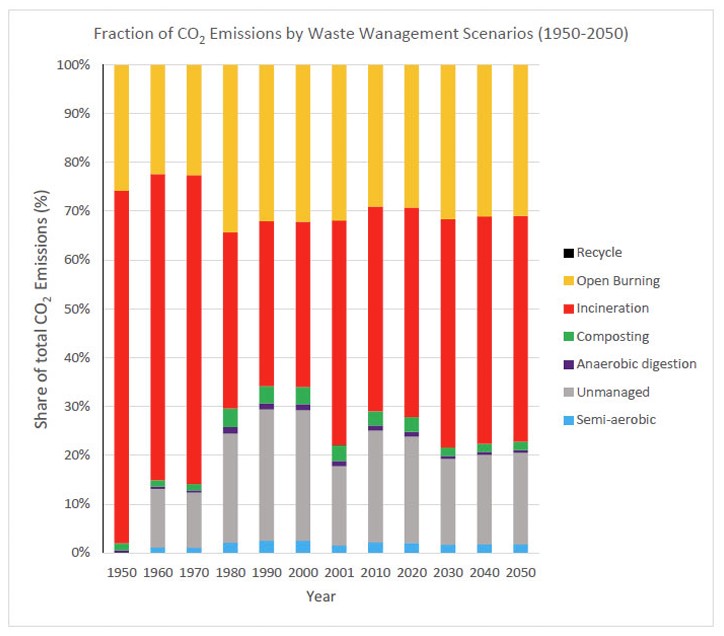
Total CO2e emissions for different waste management scenarios in lagos (1950-2050).
4. DISCUSSION
4.1. Discussion of Emissions Estimation for Carbon Credit Results (IPCC Method)
The projected emissions for solid waste disposal sites in the state of Lagos are expected to rise significantly to around 267 Gg CO2 equivalent by the year 2050 without the implementation of appropriate control measures. It is clear from the comparison analysis that the current practice of open dumping and open burning is the principal source of methane emissions. These results emphasize the importance of the adoption of designed sanitary landfills with methane capture and use technologies, which have the potential for emission reduction as well as the production of carbon credits through landfill gas capture projects [30, 32, 43, 45, 46].
Among the other mitigation options considered, anaerobic digestion has the greatest mitigation potential as it reduces methane emissions while also providing a source of renewable energy. Another form of waste diversion with lower GHG emissions than landfilling is composting, while recycling reduces GHG emissions by conserving natural materials.
Collectively, all these techniques have made a substantial contribution to mitigating climate change and resource conservation relative to the common waste management techniques available [68, 69]. But on the contrary, the high dependence on incineration without employing the necessary emission reduction techniques is a substantial factor affecting the emission of gases associated with climate change, requiring a policy focus on the utilization of biodegradable materials alongside recycled materials [70].
Concerning the negative influences of open burning on environmental matters or public health, it is documented that particulate matter levels increase due to associated respiratory illnesses [32, 71]. Improving the recycling infrastructure and linking GHG mitigation targets with local climate action plans can improve policy alignment with the country’s sustainability goals [33, 72].
On an overall basis, the findings from the above studies show that anaerobic digestion, composting, and recycling are more environmentally friendly as well as economically viable than open dumping, uncontrolled landfilling, and open burning practices. Although the conventional methods are responsible for the perpetuation of high emission rates, there are long-term climate mitigation advantages associated with sustainable waste management practices that can provide carbon credits as well as co-benefits related to public health [73-75]. Future studies need to address socio-economic factors associated with the mass adoption of such practices.
CONCLUSION
Open dumping and open burning are the most practiced waste management methods in Lagos, making them environmentally unsustainable by nature. Greenhouse gas emissions from open dumping amount to 98,463 Gg of CO2-eq, while open burning contributes 59,741 Gg of CO2-eq. From the study, it is clear that the shift to other waste management methods, such as anaerobic digestion and composting, will provide a real opportunity for the reduction of greenhouse gas emissions while enabling the participation of the project in the carbon market. Based on the carbon market price of 2024, the project will yield 631,130,700 carbon credits with an estimated value of approximately USD 1.9 billion.
These findings and results emphasize co-benefits related to a better landfill, methane capture, and waste-to-energy. These findings point toward framing policy interventions in order to promote landfill gas capture, anaerobic digestion, and composting, which could act as alternatives to dumping and burning. Promotion of a regulatory framework for carbon credit could, therefore, play an important role in raising funds for upgrading and ensuring a transition to a low-carbon waste sector.
Reliance on general IPCC default parameters, due to incomplete waste data specific to Lagos, is another point that may introduce uncertainty into the emission estimate. The second limitation is using carbon credit values based on projected 2024 market prices, considering their variability. Lastly, this study did not analyze life-cycle emissions, socio-political constraints, and infrastructure-related barriers, which need consideration in future studies. Future work should integrate local datasets, stakeholder perspectives, and scenario-based modeling as ways to enhance its robustness.
AUTHORS’ CONTRIBUTIONS
The authors confirm contribution to the paper as follows: L.R.: Investigation; A.A.: Validation; S.A.: Study concept or design; A.J.: Data analyses or interpretation. All authors have read and agreed to the published version of the manuscript.
LIST OF ABBREVIATIONS
| AD | = Anaerobic Digestion |
| CH4 | = Methane |
| CO2-eq | = Carbon dioxide equivalent |
| CDM | = Clean Development Mechanism |
| CER | = Certified Emission Reduction |
| NMVOCs | = Non-methane organic compound |
| N2O | = Nitrogen Dioxide |
| NOx | = Oxides of Nitrogen |
| CO | = Carbon Monoxide |
| DOC | = Degradable Organic Carbon |
| FOD | = First Order Decay |
| GHG | = Greenhouse Gas |
| IPCC | = Intergovernmental Panel on Climate Change |
| LAWMA | = Lagos Waste Management Authority |
| MSW | = Municipal Solid Waste |
| SWDS | = Solid Waste Disposal Site |
| WtE | = Waste-to-Energy |
AVAILABILITY OF DATA AND MATERIALS
All data generated or analyzed during this study are included in this published article.
ACKNOWLEDGEMENTS
Declared none.